Last updated on : April 28th, 2026 by R Yadav
Incoming messages are often treated as a sign that the hardest part of sales is already done. A person has seen the offer, taken interest, and started the dialogue. Yet in practice, many of these contacts do not become sales. The problem is rarely traffic alone. More often, the issue lies in how the conversation is handled after the first message arrives.
Conversion from incoming messages depends on process quality. A lead may be warm, but a weak response can cool it quickly. This principle is visible across many digital funnels, where even categories such as live casino games convert not only because of interest, but because the user meets a clear path, low friction, and timely prompts. In sales correspondence, the same rule applies: the seller must take existing interest and convert it into movement through speed, structure, relevance, and disciplined follow-up.
Many teams overestimate the value of an incoming message. They assume that because the client reached out first, the deal is already close. As a result, they reply too casually, too slowly, or too broadly. This is one of the main reasons conversion stays lower than expected.
An incoming message usually means only one thing: the person is open to further evaluation. It does not yet mean commitment, urgency, or trust. The client may be comparing several options. They may be unsure what exactly they need. They may want a quick answer and lose interest if the reply creates effort.
For this reason, incoming traffic should not be seen as “almost closed.” It should be seen as a stage with high potential and high fragility. The first responses determine whether the lead will move deeper into the process or exit it quietly.
Fast replies improve conversion because they preserve attention. When a client writes with intent and receives a timely answer, the dialogue stays alive. Delay gives room for distraction, competitor responses, or simple loss of momentum.
However, speed alone is not enough. A fast but weak answer still loses sales. Many sellers reply quickly with generic phrases such as “Hello, how can I help?” or “Please clarify your request.” These messages may be polite, but they often place the burden back on the client.
The better approach is fast and relevant response. The client should feel that their message has been understood and that the conversation is moving forward. A useful first reply usually does three things:
This lowers reply friction and makes the dialogue easier to continue.
A strong first response is not just an answer. It is a directional move. It prevents the conversation from becoming chaotic or passive.
Many incoming leads are lost because the seller responds in fragments. They answer the immediate question but do not guide the client toward the next point. As a result, the dialogue becomes reactive. The client must drive the process alone.
A stronger method is to combine answer and structure. If the client asks about price, the reply should not be only a number. It should also explain what affects the price and what the client can choose from. If the client asks whether a service is available, the reply should confirm availability and outline the next action needed to proceed.
Direction increases conversion because it reduces uncertainty. A client who sees the path is more likely to stay engaged than a client who receives isolated facts.
Not every incoming lead is ready to buy the same thing in the same way. That is why qualification matters. But many sellers damage conversion by turning qualification into interrogation.
The goal of qualification is not to collect all possible data. It is to identify the few variables that determine the right offer, the right timing, and the right closing path. In correspondence, this is especially important because every extra question increases effort.
Useful qualification often focuses on:
The best questions are narrow and justified. When the seller asks only what is needed to move the deal forward, the client feels guided rather than processed.
One of the main reasons incoming leads fail to convert is that the offer is presented in a way that is hard to process. The seller may know the product well, but the client sees only a block of text, mixed conditions, or vague promises.
An effective offer message should be structured so the client can understand it quickly. The most practical order is:
This structure improves conversion because it answers the client’s core decision questions in a usable sequence. It also makes comparison easier. If the client is evaluating several options, the clearer offer usually gains an advantage, even without the lowest price.
Many incoming leads do not disappear during discovery. They disappear near the decision stage. The client has enough interest to continue, but the final steps feel heavy. Payment is unclear. The next stage is vague. The process after confirmation is not explained.
This creates hesitation. The seller may interpret that hesitation as lack of interest, when in reality the client is facing friction.
To improve conversion, the decision stage must be simplified. The client should know:
When the final stage is operationally clear, the deal moves more easily. When the client has to guess what comes next, delay increases.
A large share of incoming leads are lost not because the initial conversation failed, but because follow-up was weak. Some sellers do not follow up at all. Others send reminders that create irritation.
Good follow-up has two traits: timing and purpose. It should arrive at a point that makes sense for the stage of the decision, and it should contain a reason to continue the exchange.
Weak follow-up messages include:
These messages add no value. They ask for attention without making the reply easier.
Stronger follow-ups reconnect to the exact stage of the deal. They may summarize the offer, clarify a detail, confirm timing, or define the next step. That is why they work better: they reduce effort instead of increasing pressure.
Conversion from incoming messages improves when conversations are managed as a pipeline rather than a series of isolated chats. Many businesses lose deals simply because there is no system for tracking what stage each lead is in, when to recontact them, and what barrier remains unresolved.
At a minimum, each incoming lead should be tracked by:
This discipline reveals where conversion is breaking. In some cases, the issue is slow first response. In others, it is weak qualification or poor closing. Without tracking, these patterns remain invisible.
One of the fastest ways to improve conversion is to review message threads that did not lead to sales. Many teams look only at closed deals and copy the visible wording from them. That helps, but it is incomplete.
Lost dialogues often show the real weaknesses of the system:
When these points are analyzed consistently, the improvement becomes practical. The goal is not to blame individual messages. The goal is to identify recurring friction points and remove them.
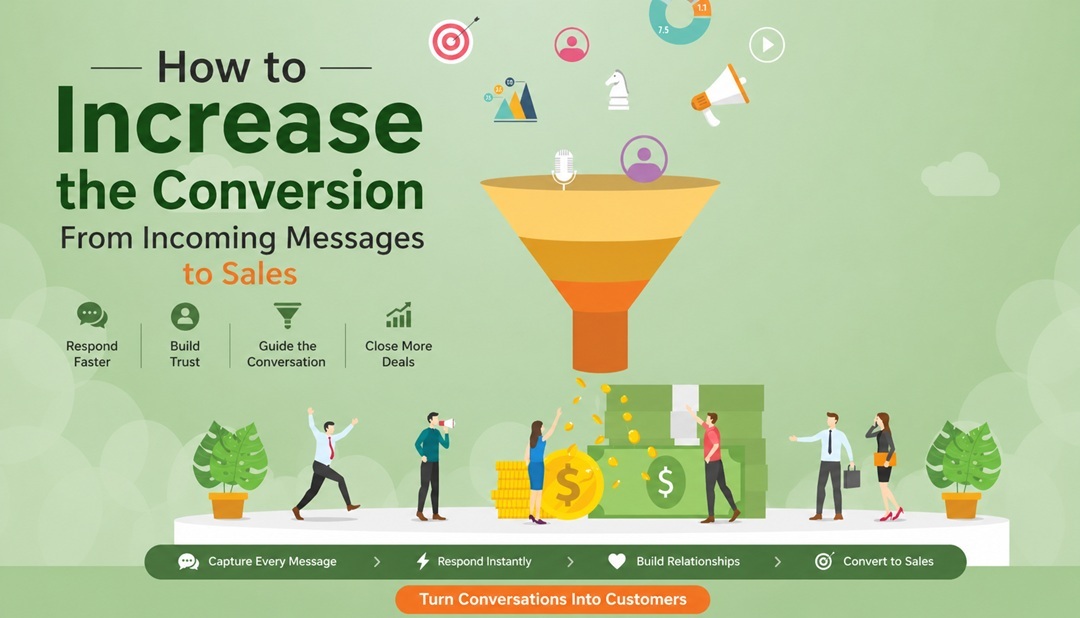
Increasing conversion from incoming messages to sales is not a matter of one script or one persuasive phrase. It is the result of a disciplined communication system. The seller must respond fast, but with relevance. They must qualify without overloading. They must present the offer in a clear order, reduce friction at the decision stage, and follow up with logic rather than pressure.
Incoming messages contain potential, not guaranteed revenue. That potential turns into sales only when the conversation is managed with structure. When each stage is designed to reduce effort and increase clarity, the path from first message to closed deal becomes shorter and more reliable.