
Last updated on : April 27th, 2026 by R Yadav
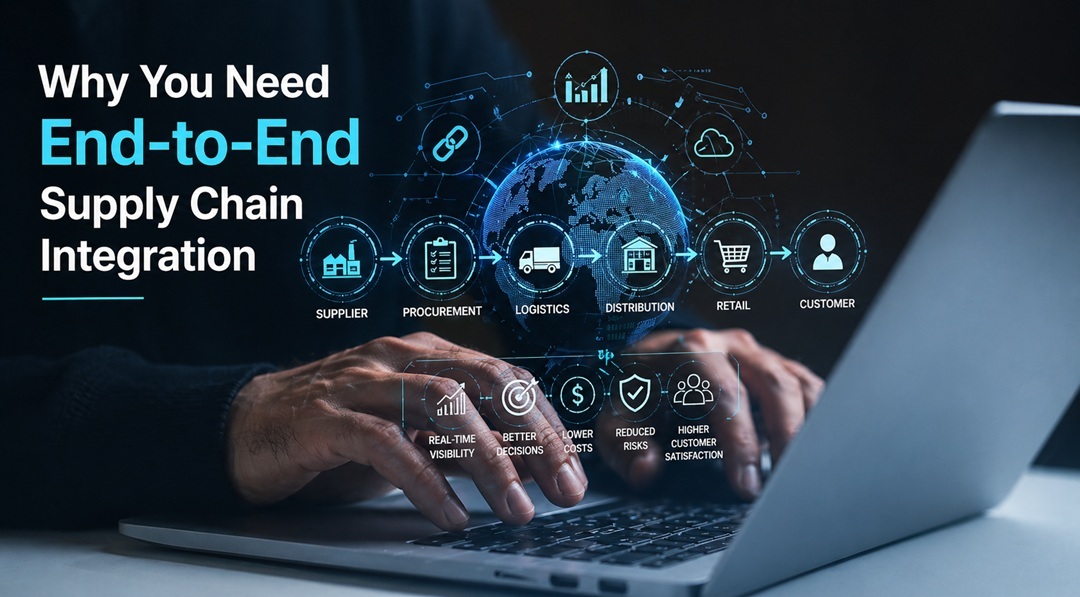
In the increasingly fast-moving global marketplace, supply chains are growing more complex, and must be integrated. Silos of discrete businesses face inefficiencies, bottlenecks and increased costs. Whole supply chain integration addresses these issues by providing a system for the flow of information, product and decisions. This allows for companies to quickly adapt to market opportunities, minimise waste and improve performance.
Full integration enables end-to-end real time monitoring. By integrating with systems and partners, companies can track stock levels and shipments and detect issues in the supply chain further up the chain. This leads to greater visibility and decision making.
More visibility brings more accountability. Sharing performance data enables efficiency to be gauged and improved. This is especially helpful in a complex supply chain with multiple suppliers, distribution centres and logistics service providers.
The integrated supply chain helps automate processes and reduces manual effort. Sharing information and processes minimises errors and accelerates processes. This helps speed up delivery cycles, optimise resources and reduce costs in the long term.
It's also easier to manage costs when supply chain partners communicate. This makes it easier for businesses to manage transport, inventory and waste through lack of communication or delays. Integration also provides greater planning to prevent over and under stocking that can impact revenue.
Supply chains can have a number of external partners including suppliers, distributors and transport providers. Integration allows partners to communicate and have a shared vision. This avoids potential communication issues and brings coordination.
Integration is important for 3PL logistics services. Integration enables companies to share data with 3PLs in real time so that they can be responsive and increase their offering. This collaboration improves supply chain and efficiency.
These days, customers expect fast service, which is an important component of the buying process. A fast supply chain enables rapid order processing and delivery. This is particularly important when it comes to last mile delivery and has an impact on customers.
It provides guaranteed service. Integration gives customers real-time information about their parcels and reduces issues. This boosts customer retention, which is critical to success in a competitive environment.
The world is changing and market conditions, economic conditions and external threats are ever evolving, so adaptability is essential. An integrated supply chain provides real time data and integrated processes for faster, more informed responses. Greater visibility and coordination enable companies to adjust production schedules, move stocks between locations and deal with issues and bottlenecks early in the process.
Another benefit of integration is the ability to grow supply chains. As firms expand, their processes become more intricate and require greater integration with other functions and partners. An integrated system helps them to navigate the complexity without losing efficiency, and be able to grow without compromises or bottlenecks.
Data is a critical part of decision making. Integration means we capture and store data from across the supply chain in a single repository. Managers can then use this to recognise patterns, measure performance and implement changes. This unified visibility also reduces reliance on assumptions and improves the accuracy of strategic planning.
Data driven decision making also supports continuous improvement. Data on performance enables identification of problems and corrective actions. This contributes to competitiveness and operational excellence in a dynamic environment. Over time, this approach helps organisations build more resilient and adaptive supply chain operations.
For firms to perform in a dynamic environment they need to integrate their supply chain. Integration of all supply chain practices enables the visibility, speed and flexibility required in a dynamic environment. This helps in improving operational efficiency, increasing customer satisfaction and growth.
Read Next: How to Use CMMS Data to Improve Spare Parts Availability