

Last updated on : August 30th, 2026 by R Yadav
Searches for an ai detector bypass or an ai detection remover have become common as AI detection software shows up more often in schools, workplaces, and publishing platforms. Before relying on any tool that promises this, it helps to understand exactly what these tools do, how detection actually works, and where the real limits are.
An AI detection tool analyzes text for statistical patterns that tend to differ between human writing and machine-generated writing. It doesn't understand meaning the way a person does. Instead, it looks at signals like sentence rhythm, word predictability, and how often certain transition phrases appear, then produces a probability score estimating how likely the text is to be AI generated
This matters because it means detection is inherently a probability exercise, not a definitive fact. Both false positives, where genuine human writing gets flagged, and false negatives, where AI-generated text passes as human, are documented limitations of current detection tools.
An ai detection remover typically works by rewriting text to reduce the specific patterns that detectors are trained to notice. This usually involves three main adjustments.
Sentence length and rhythm get varied deliberately, breaking up the uniform pacing that's common in AI generated writing.
Repetitive phrases and predictable transition words get replaced with more natural alternatives that appear less frequently in typical AI output.
Overall tone gets adjusted to feel less consistently formal, sometimes introducing contractions or more conversational phrasing depending on the setting used.
In many cases, yes, at least against a specific detector at a specific point in time. Rewriting text to reduce common AI writing patterns genuinely does improve the odds of that text passing many current detection checks. This isn't a myth. Detection tools measure identifiable patterns, and disrupting those patterns has a real, measurable effect.
What isn't realistic is expecting a permanent, universal AI detector bypass that works against every detection tool indefinitely. Detection software gets updated regularly, often specifically in response to the kinds of rewriting patterns that detection remover tools produce. A rewrite that passes today isn't guaranteed to still pass on an updated version of that same detector next month, or on a different detector entirely.
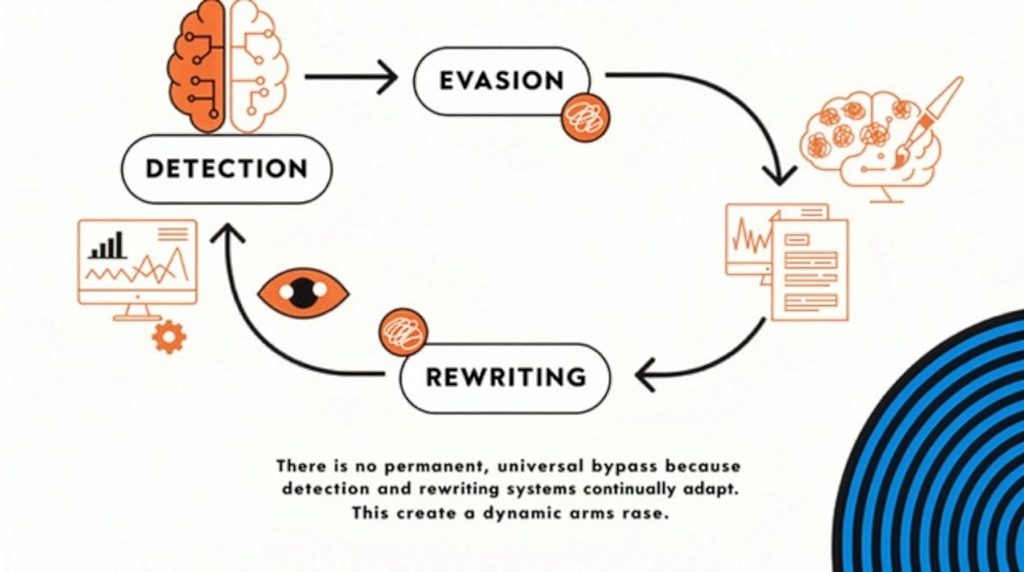
Detection tools and detection remover tools exist in a continuous back and forth. When a detector improves at catching a certain pattern, detection remover tools tend to adjust, and the cycle repeats. This dynamic means any claim of a guaranteed, permanent ai detector bypass is making a promise that isn't backed by how this technology actually behaves over time. Treating that kind of claim as reliable sets up a real risk of being wrong exactly when it matters most.
Many schools and workplaces have explicit rules about submitting AI-generated work as original human effort. Using an AI detection remover specifically to disguise fully AI-generated content in a setting with those rules can violate policy regardless of whether any particular detector actually flags the result. The underlying issue is the misrepresentation itself, not just whether software catches it.
Heavier rewrites aimed at maximizing detection avoidance can introduce small factual drift or awkward phrasing, particularly with technical or detail heavy content. A rewrite that reads more naturally but subtly changes meaning isn't actually an improvement.
Believing a tool has permanently solved detection can lead to skipping genuine review before submitting or publishing something, based on confidence that isn't actually well founded given how quickly detection accuracy shifts.
Rather than chasing a permanent ai detector bypass, the more dependable goal is producing writing that's genuinely well edited and reads naturally for real reasons. This includes varying sentence structure deliberately, cutting repetitive phrasing, adding specific personal details a language model couldn't generate, and reviewing the final result carefully against the original for accuracy.
This approach holds up better over time than relying on any detection remover tool alone, since it isn't dependent on staying one step ahead of whatever a specific detector happens to check for this month. Writing that's actually well edited tends to read as natural regardless of what any detector concludes about it.
In many everyday situations, like polishing a blog draft, refining marketing copy, or improving an email, detection avoidance isn't really the point at all. The actual goal is writing that sounds natural and reflects a genuine voice. In these cases, the same techniques used in an ai detection remover, varying sentence rhythm, reducing repetitive phrasing, adjusting tone, are valuable purely for improving writing quality, with any effect on detection being a secondary benefit rather than the main objective.
An ai detector bypass is achievable against specific detectors at specific points in time, and tools built for this purpose can genuinely reduce common AI writing patterns. What isn't realistic is treating any ai detection remover as a permanent, guaranteed solution, since detection systems and rewriting tools continue to adapt to each other constantly. The safer, more dependable path is focusing on writing that's genuinely well edited and honestly represents real effort, since that approach holds up regardless of what any particular detector concludes, and it avoids the real risks that come with treating detection evasion as the actual end goal.
Read Next: Humanizing AI Writing: Common Myths vs What's Actually True