Last updated on : August 20th, 2026 by R Yadav
The Fed held rates steady on June 18 — fourth meeting in a row, nothing shocking on paper. And yet Bitcoin still managed to whipsaw violently within twelve hours before settling back down. If you're sitting on spot crypto and watching that kind of move happen in real time, you start asking yourself an uncomfortable question: how do you stay bullish on the bigger picture without letting a couple of bad days wipe out a month of gains?
This is basically the whole pitch for perpetual futures.
Unlike a normal futures contract, a perpetual doesn't expire. There's no rollover date, no forced settlement — you just hold the position until you decide to close it, or the market closes it for you. That lack of an expiry is the defining feature separating perpetuals from traditional dated futures contracts. And because you can go long or short, you're not locked into "line goes up" as your only path to making money. That short side is the part spot holders actually care about — it's what turns a perpetual contract from a speculative toy into something closer to a real risk management tool.
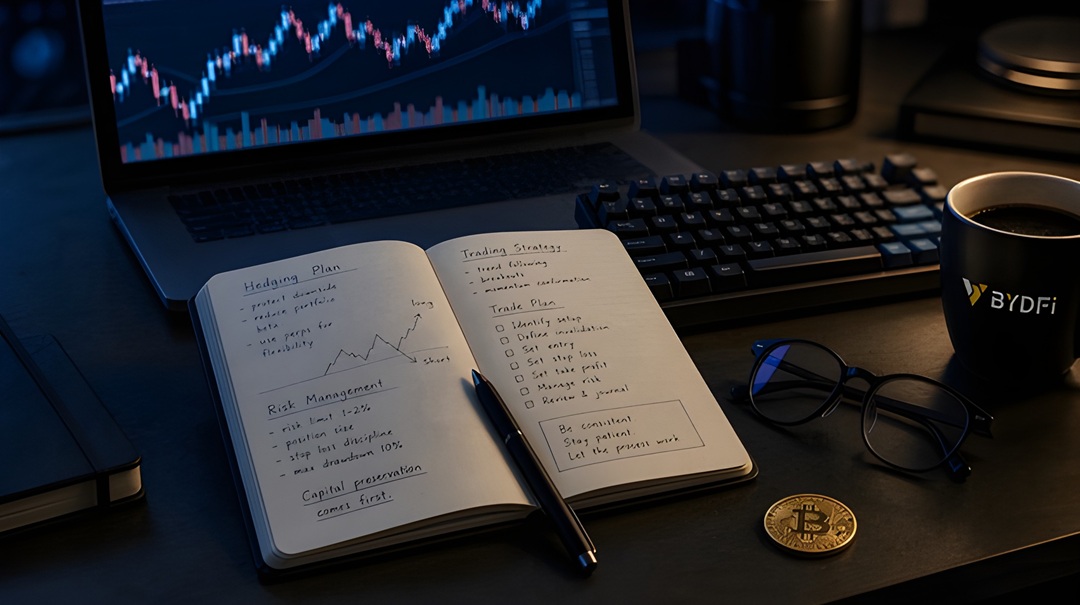
Say you're holding 1 BTC in spot and there's a Fed announcement coming up that makes you nervous. The move is simple enough: open a BTC short on the perpetual side to offset the position you already own. If price drops, the short gains value, cushioning the hit to your spot holding. Your actual BTC never moves.
Leverage on perpetual contracts can typically run anywhere from 1x up into the hundreds, depending on the platform. But if you're hedging rather than gambling, the general practice is to stay low — often 1x to 5x — enough to roughly match your existing spot exposure without turning a defensive trade into a new source of risk. Higher leverage ceilings exist mainly for traders with a very different risk appetite than "protect what I already have."
Isolated margin tends to be the more prudent choice for this kind of trade. It ring-fences your risk to whatever collateral you've allocated to that single position, so a bad trade doesn't start eating into everything else you're holding. Most platforms also offer order types like Limit, Stop-Limit, and Take-Profit/Stop-Loss, which give you real control over entries and exits instead of just eyeballing the chart.
This decision matters more than people give it credit for. Cross margin pools your funds across every open position, which is capital-efficient but means a loss on one trade can drag down the others. Isolated margin keeps things walled off — safer, but less flexible. If you're running a hedge on one asset alongside a directional trade on another, you'll feel that trade-off directly.
Many platforms now offer a choice of collateral — stablecoin-margined contracts (USDT or USDC, for example) alongside coin-margined ones. Having that choice means you can post margin using whatever you're already holding, rather than converting assets just to open a position.
Some exchanges have also introduced shared-fund or "full-margin" modes, where available capital across an account can cushion an individual position and reduce the odds of an isolated liquidation. Similar upgrades have allowed traders to open new positions using unrealized profit from existing ones — useful in fast-moving markets where waiting for a settlement isn't practical.
Perpetuals don't have an expiry to force the contract price back in line with spot, so instead they rely on funding rates — periodic payments exchanged between long and short holders, typically every eight hours, to keep the two prices tethered together. If you're short and funding is positive, you're getting paid to hold the hedge. Nice, while it lasts. But funding flips. When it goes negative, a "free" hedge starts quietly costing money every eight hours, and it's easy not to notice until you check the account and wonder where the bleed came from.
If you're holding a perpetual position for more than a few hours, checking funding isn't optional. Several data aggregators publish funding-rate dashboards that let you compare rates across exchanges — worth bookmarking if you plan to hold positions for any length of time.
Some platforms allow bi-directional hedging — holding both a long and a short on the same pair, at the same time. That opens the door to delta-neutral strategies, where you're not really betting on direction at all, just trying to capture funding income or volatility while staying roughly market-neutral overall.
For range-bound markets, automated grid-trading tools built on top of perpetual contracts are another option — designed to capture volatility systematically rather than relying on a single directional call. Many platforms also offer demo or paper-trading environments with simulated funds, which are a reasonable way to get familiar with the mechanics. Just don't expect a sandbox to replicate what it actually feels like when it's your own money on the line — nothing really does.
Onboarding requirements for futures trading vary by platform and by jurisdiction — verification levels, withdrawal tiers, and eligibility all differ, so it's worth confirming your local regulatory requirements before diving in.
Copy-trading features, where you automatically mirror trades from other traders with proportional position sizing, have also become common. Entry costs for these can be low, but the standard disclaimer applies and is worth actually meaning: past performance doesn't guarantee anything, and copy trading carries the same risk of total loss as any other leveraged position.
Fee structures typically scale with trading volume — lower maker/taker fees for higher-volume traders, often through tiered VIP-style programs. It's worth comparing fee schedules across platforms rather than assuming they're all similar, since the difference between tiers can be meaningful over time.
Because perpetual futures involve leverage and rely on the exchange itself to manage margin, liquidations, and custody, the operating history and transparency of a platform is worth real scrutiny — not just the mechanics of the product. Things worth checking before committing capital:
Self-reported figures from any exchange should be treated as a starting point for research, not a final answer.
One signal traders increasingly track is the basis spread between CME futures and spot prices heading into major Fed meetings. If that spread compresses while open interest climbs, some read it as a sign of increased institutional hedging activity — though, as with most patterns in this market, it's suggestive at best, not predictive.
That's the kind of environment where hedging, copy trading, and grid strategies actually get tested for real. Understanding the mechanics — margin modes, leverage, funding rates, and order types — is what turns perpetual futures from a speculative bet into a genuine tool for managing risk around volatility events, rather than just reacting to them after the fact.
Read Next: Best Instagram Downloaders in 2026: Comparing Popular Tools for Saving Videos, Reels, and Photos